
A big part of Woolsey history quietly succumbed to the elements a few Sundays ago.
The giant, old barn just east of downtown Woolsey had been barely standing for years, but it finally gave way and is flat on the ground now.
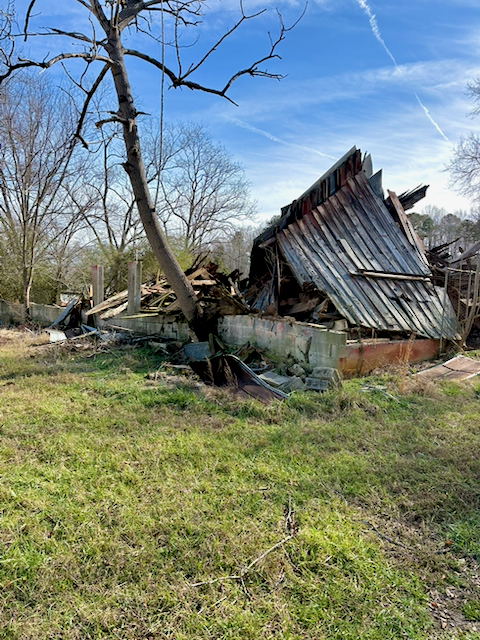
The old barn’s current state. Photo credit: Frank Carden
It was a massive structure in its prime. Frank Carden, the current owner, said he believes the barn was initially built more than 100 years ago by the Woolsey family that the town is named for.
The barn was constructed using massive 12-inch-square beams. There were stalls for mules, a room for harnesses, and other areas topped by a massive loft used for storage of hay and other feed.
It was part of a 900-acre farm that was eventually sold to Mr. William Battle Baker, a wealthy Atlanta industrialist who owned the Atlantic Ice and Coal Company. Mr. Baker, who lived in the antebellum house that recently burned, moved to Woolsey to run the farm, which included traditional crops and livestock as well as a peach orchard that included a packing house.
One Sunday in 1932, Mr. Baker went to rescue one of his farm hands who was being terrorized by some troublemakers but wound up being shot and killed himself.
William Mitchell, then the president of Georgia Power Company, purchased the farm, and his family owned the property until 1978, when it was subdivided and sold. During the Mitchell’s ownership, Bub Carden, Frank’s dad, rented the pastures and the barn and began storing square bales of hay inside.
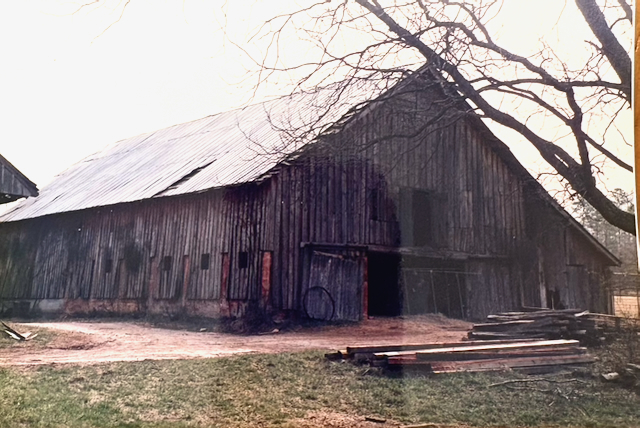
The Woolsey barn in its prime. Photo credit: Frank Carden
Like many other young fellows who came of age in that era, I spent many a hot day hauling hay to the barn and helping stack it in the loft. It was hard work, but the camaraderie was such that you didn’t want to be left out come hay-baling time.
Much of that Coastal Bermuda hay came from a field on Mud Bridge Road that turned out thousands of bales each year. I remember one baling that produced around 2,500 bales.
Most of the hay was hauled on long-bed, half-ton pickups. On hay baling weekends, it seemed like every truck in Inman and Woolsey, and some more from Fayetteville, were pressed into service.
We could get a little over 50 bales on each truck.
We put eight bales sitting flat, strings up, on the bed of the truck. Then we made two layers of 11, with each layer featuring four bales on each side sitting perpendicular to the truck with about a third of each bale hanging out over the side of the truck bed. Three bales were placed straight down the middle.
For the next layer we’d put nine bales – three abreast and three deep. By placing the bales that way, the weight of the bales on the fourth tier helped keep the bales on the two rows below from falling off the truck. That was topped pyramid-style by a layer of six, two abreast, three deep. The top consisted of three bales in a row down the center of the stack. The top three rows tied the whole works together.
Lastly, three bales were stacked on the tailgate, pushing the load to 51 bales.
Properly stacked, that hay would ride at a reasonable speed without being tied down. Still, it was always a challenge getting through bumps and uneven paths to get a load to the barn without dumping some off.
Once at the barn, a conveyor powered by a small gasoline engine was used to lift the bales up to the loft, where they were toted to the back and stacked.
Today, round balers have eliminated those chores, as well as the winter-time work of removing the bales from the barn and taking them to the pastures for cattle to eat.
Bye-bye old barn. You will be missed.