
In an earlier era, lots of folks around Inman had a watermelon patch every summer. My cousin and neighbor Mickey Harp and I were familiar with lots of those patches, as we often got recruited to help pick, load and sell the melons. But neither of us can ever recall a watermelon patch as good as the one we grew in the 1980s.
We planted the gray field between my house and the cemetery. It hadn’t been farmed for a good while and that’s what you’re looking for when choosing a watermelon patch. We planted mostly Crimson Sweets and Sugar Babies. The Crimson Sweets were an old standard, while the Sugar Babies were new, a response to consumers wanting a small melon they could put in a refrigerator without crowding out the rest of the groceries.
The vines took off and were growing good, starting to run into the wide middles when a coat of grass appeared. Rain was in the forecast, and I was rushing around to cultivate them before the rain. If it rained the vines would run so much that it would be impossible to plow out the grass.
As it was, I had to manually turn the vines in line with the rows before I could cultivate with a Farmall Super C. Then afterwards the vines would need to be turned back like they were before.
Just as I started turning the vines, B.J. Lamb, the preacher at the Inman Methodist Church (as well as Brooks Methodist and Union Chapel) stopped by the field.
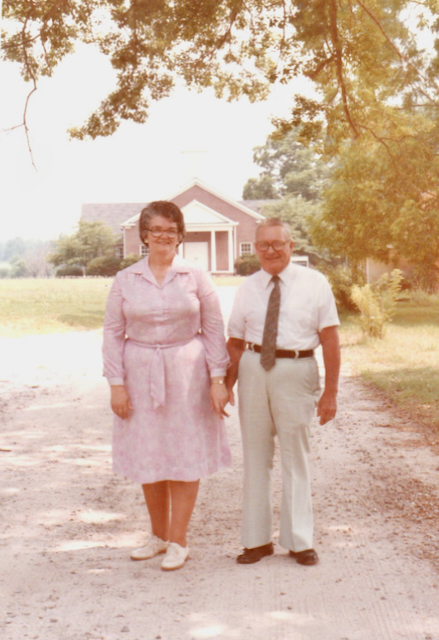
Christine and B.J. Lamb. Photo by Frances Reeves
Knowing rain was on the way, he started turning vines and told me to get started plowing. Between the two of us, we got the field plowed and the vines turned in line and then back the way they were before the rain started.
We ended up getting a good, soaking rain. The vines covered the field with few weeds in sight.
B.J. had saved the day.
Mickey and I sold a good many watermelons, but it had turned off dry and the yield wasn’t anything to brag about. When the melons had been picked, we got busy with other things and the wilting vines just sat there.
Finally we got some good rain. The vines perked up, put on new blooms. Soon we had a bumper crop of beautiful, big, tasty Crimson Sweets.
The first time we picked them we loaded up every truck we owned and several that we borrowed.
The Sugar Baby vines were loaded too, but Mickey and I couldn’t figure out which ones were ripe. Even his dad, Donald Harp Sr., an excellent farmer, was stumped. We picked about 100 of them and put them on a truck.
When you arrive at the Farmers Market in Forest Park with watermelons, an inspector takes a long, skinny knife and samples your melons. If you don’t pass inspection, you can’t sell them. It’s a high-anxiety moment for sure.
Our Crimson Sweets passed with no problem. The Sugar Babies were another story. The first one or two that the inspector cut weren’t ripe. The inspector was helpful, and said he’d show us how to thump them and determine ripeness.
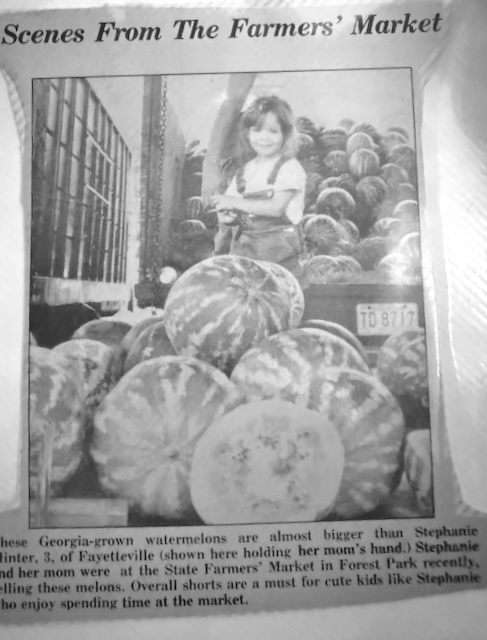
Newspaper article with Stephanie standing with the watermelons she and Joanne were selling.
But even he couldn’t figure it out. We all agreed we shouldn’t sell them on the market, and we didn’t.
The Crimson Sweets hit the market at just the right time. Even though watermelons generally quit selling around Labor Day, there weren’t many other farmers there with melons and we sold ours with relative ease.
We hauled for a couple of weeks off that patch, which couldn’t have been over two or three acres.
Mickey and I were talking about that crop a few days ago, and about how ironic it is that neither one of us can grow a decent watermelon these days.